Showing posts with label Photography. Show all posts

Saturday, March 21, 2015

Wasted Beauty


Two images.

The first, a photograph in black and white that captured a situation in a fraction of a second.
The other, a painting, full of vivid colours depicting a rather static scene.


Different media, different formal qualities and yet so relevant, as if they were meant to be placed one next to the other.

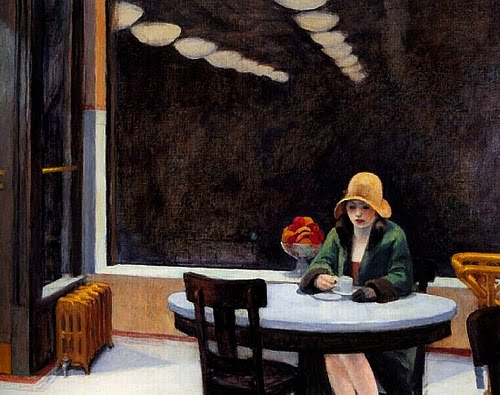
Two young girls working in public spaces, serving crowds that hardly notice their existence. It seems as if they were visible only to the eyes of the artists, Robert Frank and Edward Hopper.

The look of the elevator girl and the body posture of the cinema girl radiate the boredom and the frustration caused by their repetitive, uninteresting jobs.

Jack Kerouac, who wrote the foreword of the legendary book The Americans where the photograph belongs, asked Frank if hew new the girl's telephone number. I am sure he wouldn't mind dating the blonde from the painting either.

Luckily we have Art to preserve some humanity in this mechanical world.

Friday, February 6, 2015

Van Gogh and Vivian Maier


I have seen people weeping when overwhelmed by the power of a work of art. I wish I had this kind of sensitivity, but I don't. When I burst into tears, it is because of human beings and their tragic destinies.

One of the most heartbreaking stories among artists is the one of Vincent van Gogh. The painter whose name became almost a synonym for his art, a cursed soul that has been struggling between genius and insanity (I am not strictly speaking mad, for my mind is absolutely normal in the intervals, and even more so than before. But during the attacks it is terrible—and then I lose consciousness of everything. But that spurs me on to work and to seriousness, as a miner who is always in danger makes haste in what he does, he wrote [1]), with a feverish talent that distinguished him from anyone before or after, this person so desperate for recognition as anyone involved in creative activities can be, died without having sold any of his works, that later would be globally considered as masterpieces.


Vincent was thirty-seven [when he shot himself]. The abbot in Auvers refused to allow a funeral service in his church. Van Gogh was foreign and Protestant and a suicide.

So Theo
(his brother) bought a plot in a new cemetery on a barren plateau above the town, a distance from the church. Vincent was in his element, among the wheat fields, under the sun and stars, an outlier, as always. [1]

By a strange coincidence it was in Amsterdam (at FOAM), a few hundreds of meters away from the van Gogh Museum, that I saw the exhibition of Vivian Maier, a photographer with a similar fate:

Vivian Maier (New York, 1926 - 2009) worked as a professional nanny throughout her life. In her free time, she documented life in large American cities such as New York and Chicago, although no one in her immediate circle ever saw the results. She left behind an imposing body of work, consisting of 100,000 negatives. Its quality can be compared to that of famed contemporaries like Joel Sternfeld, Joel Meyerowitz, Elliot Erwitt and Garry Winogrand. [...]

In 1951 she became a nanny, work she continued to do for the rest of her life. Those who were acquainted with her characterised Maier as extremely intelligent, eccentric, curious and a free spirit. She documented all that caught her attention, in photos as well as sound and motion pictures. On the street she was fairly inconspicuous: she wore a hat, a long dress, a woollen coat and men's shoes, and she never left the house without a camera around her neck.
[2]


Although, it seems, Vivian Maier had not received any formal education on Art or Photography, with my modest knowledge on the topic, I can say that her work is comparable to those of the legends of street photography.

In the 1990's, because of financial problems, she had to stop taking photographs. Her photo archive with the rest of her possessions were auctioned because she could not afford to pay her rent.

In 2008 Maier suffered a nasty fall on the ice in Chicago and died in April 2009. She left behind an immense photographic archive. [2]

The work of V.M can be seen at: www.vivianmaier.com


But then again, Vivian Maier was blessed like those glorious few, who manage to spend most of their lives doing what they love the most.

Real artists paint things not as they are, but as they feel them.
Vincent


[1] http://www.nybooks.com/articles/archives/2015/feb/05/van-gogh-courage-and-cunning/?insrc=whc
[2] www.foam.com, from the catalogue of the exhibition

Friday, July 26, 2013

The dark world of Antoine D'Agata


I read that photographer Antoine D'Agata won a great award for his book, titled "Anticorps", at the annual photography festival of Arles. Immediately my mind went a few years back when I met him at the same city, where I went to attend his workshop. I still wonder what made me choose him among so many other photographers. Maybe it was the fact that he had already become a hot name in the world of photography, or the curiosity how his workshop would be, taking into account his personal work: dark, feverish images full of sex, drugs and human flesh.


Getting along with him was tough. He can be as raw as his pictures are and he was pushing everyone to the same extreme limits that he pushes himself. I remember some girls often bursting to tears and as far as I was concerned, I felt detached from the whole process and demotivated. I thought I had made a wrong choice and compromised with the idea that this workshop was for me a waste of time and optimism. I kept shooting photos only for the shake of the rest of the class and they were terrible.

One evening, after a very long day of lesson, shooting and merciless critique we ended up having a drink at the famous "yellow house" of Van Gogh, which is now a bar on the main square of Arles. I was exhausted physically, mentally and psychologically and I was looking forward to finish my drink and go back to my hotel to collapse. When I mentioned my intention, D'Agata told me that this was the right moment to go to shoot photos. I thought he was kidding, but no, he meant every word. I asked him if he was tired and he replied, no, not at all, despite the 48 consecutive sleepless hours (he also mentioned his record was 76 or so, no surprise one of his books is called "Insomnia")... He suggested that I should do something extreme, like walking to Marseille (200 km away) or punch someone and see what will happen. I realized that there was a whole universe separating our worlds, but somehow I appreciated his effort and started understanding his point of view.


The next day I decided to skip the workshop and I went to see various exhibitions around the town. I ended up to the exhibition of D'Agata. I already knew many photos, but there were some I had never seen before. The experience of the previous night at the bar made me see them with a different eye. I am neither conservative, nor a puritan, however some the images shocked me and others disturbed me deeply. After I left the exhibition I realized that these particular images got imprinted in my mind for hours, even days. My response to them was developing with time and when I managed to become honest to myself, I realized with shameful surprise that they were also exciting, in a very instinctive or subconscious level that I have probably been trained to dig deep under multiple layers of good manners and moral principles. It was then that I made some sense out of the work of this unusual man. He takes long, desperate dives into the dark corners of the soul, where one usually does not dare to look, where unacceptable thoughts and unspeakable desires are pushed and brings them to the surface. D'Agata shoots daemons, his daemons, our daemons.


One day, desperate with our bad photographs, he said to someone (it could very well have been me, but it was not): "Let's go back to the basics, why do you photograph?". I don't remember the response of the poor guy. but I remember very well the answer of D'Agata when I addressed the same question to him: "All I want is to keep on living in this world of sex and drugs and photography is the way I found to do it and be paid for it". Only much later, I realized that this sentence was the only, but very important lesson I learned in this workshop: the life and the work of a true artist are one and the same thing.


Some years later, an exhibition based on his work "Anticorps" was presented in the city where I live. A text written by him accompanied the photographs. I kept some passages that show his own views on his work:

The only freedom for those who have nothing, lies in self destruction. Refusing to reduce themselves to servitude, they find an outlet in sex, drugs and violence. In the same way, depravity has always been for me, a step towards emancipation. Years of slow and reasoned self-destruction, of narcotic experimentation, of urban survival and liaisons with prostitutes, have provoked in me a slow process of maturation on these questions. I cannot risk on purpose, my destiny without getting too close, that is removing the physical distance from the photographed body, coming materially into contact, seeing beyond and smelling odours, totally immersing myself through the senses and the nerves and eliciting physical reactions also in the self and the other. I photograph carnal relationships, scenes of ecstasies:I look at shattered bodies that struggle and console the other in primitive copulations. I have sex with prostitutes and I lick flesh and bodily fluids as an antidote to the profound silence that weighs on minds dehumanized by global economy and religion. My photography is developing immunity to stereotypical morals. It is condemned to be subversive, asocial, atheistic, erotic and immoral.

Instead of reducing photography to the sole capacity of recording reality, I take responsibility for the position I assume. Rejecting voyeuristic or sociological standpoints, the images ensure art and action are inseparable in the frantic search for the feeling of being alive, of being part of life. In this fragile attempt, the image is defined both through and within the act that engenders it. It's not my insight into the world that matters but my most intimate rapport with the world. I structure a physical and psychic path overshadowed by deformity, rejection, dependence, pain, numbness, estrangement, risk, hazard, desire or unconsciousness.


Thursday, May 24, 2012

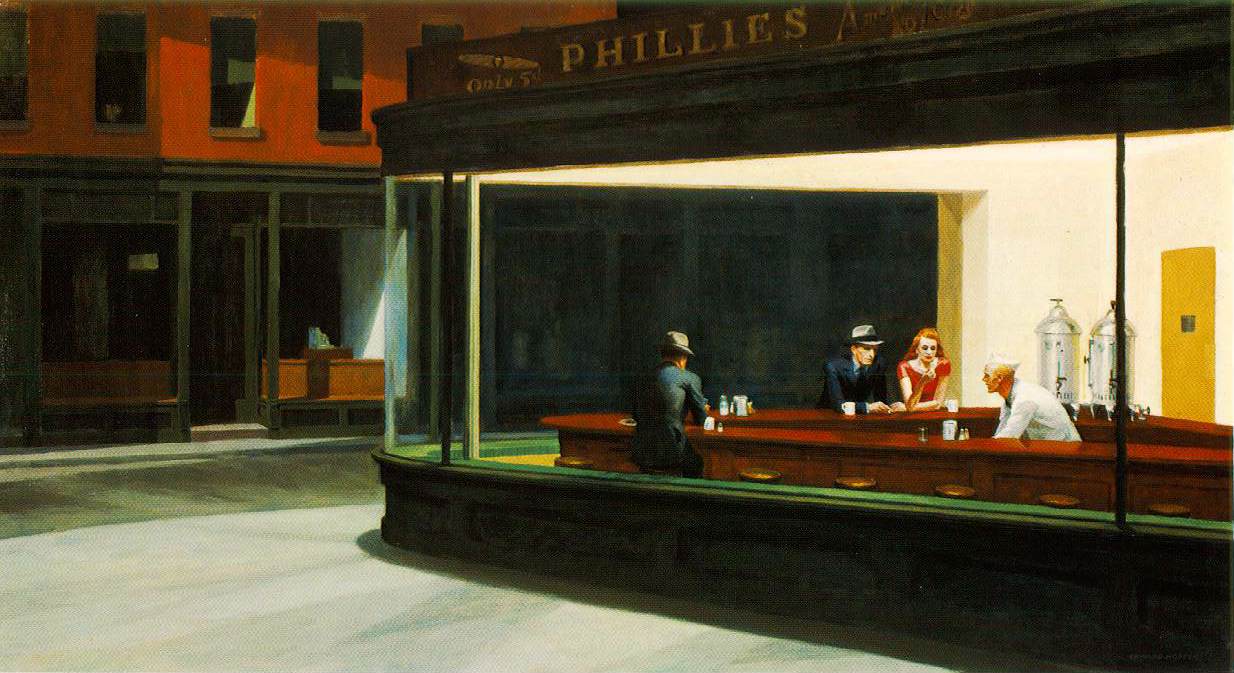
Cartier-Bresson και Edward Hopper

Ο Henri Cartier-Bresson είναι, ίσως, ο φωτογράφος που συνέβαλε περισσότερο από οποιονδήποτε άλλον στο να αναγνωριστεί ένα μηχανικό μέσο, όπως είναι η φωτογραφία, σαν μορφή καλλιτεχνικής έκφρασης. Από μικρός ήθελε να γίνει ζωγράφος και όταν έφτασε σε μεγάλη ηλικία και εγκατέλειψε την φωτογραφική μηχανή, έπιασε τα πινέλα και άρχισε να ζωγραφίζει. Βλέποντας τις φωτογραφίες του, πολλές από αυτές μοιάζουν σαν πίνακες ζωγραφικής. Ένας φωτογράφος που ζωγράφιζε πάνω στο φιλμ.


Την αντίστροφη διαδρομή, έχω την αίσθηση, ακολουθεί το έργο του ζωγράφου Edward Hopper. Tα θέματα του είναι κατεξοχήν φωτογραφικά και η τεχνοτροπία του υπογραμμίζει την αναφορά στη φωτογραφική τέχνη. Ένας ζωγράφος που φωτογράφιζε πάνω στον καμβά.


Saturday, February 25, 2012

Anders Petersen

The only true philosopher I had the privilege to meet in person: the Swedish photographer Anders Petersen.
I think it is worth to watch this short interview of his, even if one is not interested in photography

Anders Petersen from Türkiye'de Zaman/Time in Turkey on Vimeo.

Friday, January 14, 2011

Fortino Samano

Από ένα απο τα πολλά φωτογραφικά sites τα οποία μου στέλνουν τα newsletters τους κάθε εβδομαδα, έλαβα, μεταξύ πολλών άλλων, αυτή την φωτογραφία:


Μου έκανε αμέσως εντύπωση. "Ο τύπος είναι η επιτομή του cool", σκέφτηκα. Μετά διάβασα τη λεζάντα: Fortino Samano Moments before His Execution, 1916. Χωρίς δισταγμό τον ανακύρηξα σε ήρωα μου. Όπως συνηθίζουμε, πλέον, με ό,τι μας κάνει εντύπωση, τον αναζήτησα στο google. Ιδού μερικές πληροφορίες για αυτόν τον τύπο που φυσάει αδιάφορα τον καπνό του στον Χάρο:

Ο εικονιζόμενος είναι ο Μεξικανός υπολοχαγός του Ζαπάτα, που εκτελέστηκε το 1916 από τον ομοσπονδιακό στρατό. Δευτερόλεπτα πριν την εκτέλεσή του ζήτησε ένα τσιγάρο και πόζαρε ακουμπισμένος σε ένα πέτρινο τοίχο, χαμογελώντας άφοβα στο φακό του Agustin Victor-Casasola. Στάση τόσο παράδοξα γενναία για έναν άνθρωπο, που έχει απέναντι του τον εκτελεστή του !!!

Η περίπτωση του φάινεται οτι ενέπνευσε τον Θανάση Παπακωνσταντίνου που έγραψε ένα ομώνυμο με τον μάγκα τραγούδι:


Ο Φορτίνο Σαμάνο
καπνίζει και σκέφτεται:
Είμαι ό,τι δεν έζησα,
είμαι η βροχή που θα 'ρθει
να δροσίσει άγνωστων
γυναικών το κορμί.


Ο στρατιώτης με τ' όπλο
σημαδεύει και σκέφτεται:
Με μια κίνηση απλή
θα του κλέψω ό,τι έχει ζήσει.
Είμ' ένας μικρός θεός,
είμ' ένα στοιχειό.


Το τελευταίο τσιγάρο
κι εκείνο σκέφτεται:
Θα γίνω γέλιο να κρυφτώ
σε παιδιά που ξεφαντώνουν
Ο καιρός θα χάνεται
ώσπου κάποιο απ' αυτά
θα φωνάξει "λιμπερτά".
Κι όπως θα κοιτάει τις κάνες
θα βρεθώ στα χείλη του
σαν τσιγάρο ξανά.

Δεν έχω ακούσει το τραγούδι, αλλά αν ήμουν τραγουδοποιός θα του έγραφα και εγώ ένα.

Saturday, April 24, 2010

What are we?

"One of the last, and most horrific, public lynchings in America took place in October 1934, in the Florida Panhandle, where a crowd of as many as 5,000 gathered to watch what had been advertised hours earlier in the local press. Claude Neal was burned and castrated, had his genitals stuffed into his mouth, and was forced to tell his torturers that he enjoyed their taste. After he was finally dragged to his death behind a car, his mutilated corpse was urinated upon by the crowds, and then hung from the Marianna Courthouse."[1]

 In the summer of 2009 I visited the photography festival of Arles, in France. It is one of the biggest photography events in the world, with a huge number of happenings, exhibitions, seminars etc. I saw so many exhibitions that my eyes started hurting me and definitely my mind started becoming a bit insensitive to the visual stimuli. Then, one morning I entered one more exhibition area, hosting a series of photographs with the strange title "Without Sanctuary".

I entered the room bored and almost indifferent to whatever could be there. I immediately noticed that, contrary to all the other exhibitions that were contemporary, this one was about very old images, some of them in bad shape, yellowish and small in size. Like photos from a very old family album. Then I saw people hung from poles, burned bodies surrounded by curious spectators. The exhibition was a collection of photos about lynching of black people in USA, in the late 19th- early 20th century. I was taken by surprise...

Had I gone to an exhibition about the holocaust, I would know what to expect, I would be prepared. But there I was defenseless. In front of this raw, absurd, unjustified cruelty, this profound sadism, I got convinced that evil is so inherent in human nature, like never before.
I will never forget two things : one photo of the remains of a burned man, and in the back the handwritten comment (of the photographer? the owner of the photo?): "this is the barbeque we had last night".


Τhe second was the story of a mother watching her son being burned alive, and having to wait till the end of the "party", to get his remains in order bury them.
I left the exhibition with my stomach upside-down and with the question - WHAT ARE WE? - haunting my mind.

The photos of the exhibition can be found at: www.withoutsanctuary.org