Showing posts with label Art. Show all posts

Sunday, March 3, 2019

Για τον Vincent


Η σκέψη που μου ήρθε βλέποντας αυτά τα δύο γλυπτά του Zadkine για τον Van Gogh:


Αν από την Τέχνη αφαιρέσεις το glamour και το χρήμα αυτό που μένει είναι ο Vincent.


(Van Gogh brothers)

Sunday, June 21, 2015

The mechanics of Sisyphus


MC Escher commented on his work Ascending and Descending:

“That staircase is a rather sad, pessimistic subject, as well as being very profound and absurd. With similar questions on his lips, our own Albert Camus has just smashed into a tree in his friend’s car and killed himself. An absurd death, which had rather an effect on me. Yes, yes, we climb up and up, we imagine we are ascending; every step is about 10 inches high, terribly tiring – and where does it all get us? Nowhere.”


Saturday, March 21, 2015

Wasted Beauty


Two images.

The first, a photograph in black and white that captured a situation in a fraction of a second.
The other, a painting, full of vivid colours depicting a rather static scene.


Different media, different formal qualities and yet so relevant, as if they were meant to be placed one next to the other.

Two young girls working in public spaces, serving crowds that hardly notice their existence. It seems as if they were visible only to the eyes of the artists, Robert Frank and Edward Hopper.

The look of the elevator girl and the body posture of the cinema girl radiate the boredom and the frustration caused by their repetitive, uninteresting jobs.

Jack Kerouac, who wrote the foreword of the legendary book The Americans where the photograph belongs, asked Frank if hew new the girl's telephone number. I am sure he wouldn't mind dating the blonde from the painting either.

Luckily we have Art to preserve some humanity in this mechanical world.

Saturday, March 14, 2015

Κυριακή απόγευμα σε έναν ήσυχο επαρχιακό δρόμο.


Υπάρχουν άνθρωποι που έχουν την βαθειά εσωτερική ανάγκη να επικοινωνούν με το κάρμα τους, να ονειροπολούν, να αποτραβιούνται για λίγο από την πεζή πραγματικότητα και να ταξιδεύουν στη σφαίρα του αφηρημένου. Και άλλοι που την ανάγκη αυτή δεν την αισθάνονται, δεν την καταλαβαίνουν και επιμένουν να επαναφέρουν τους "ταξιδιώτες" στον πρακτικό τους κόσμο.


Κάτι τέτοιο απεικονίζει ο πίνακας του Edward Hopper, Four Lane Road (1956).


Ο άντρας, χαλαρωμένος από τον καπνό του πούρου του, ρεμβάζει, βυθισμένος στις σκέψεις του, το ηλιοβασίλεμα. Από το παράθυρο ξεπροβάλλει η γυναίκα του γεμάτη ένταση.
Το φαγητό είναι έτοιμο! Έλα προτού κρυώσει! του φωνάζει.
Εκείνος θα ήθελε να την αγνοήσει, να συνεχίσει την αιθεροβασία του. Η ζημιά όμως έγινε. Το σφιγμένο αριστερό του χέρι μαρτυρά ότι η γαλήνη του έχει πια χαθεί.

Ο τίτλος που δίνω εγώ στον πίνακα είναι "Το Κάρμα και η Φασολάδα"

Γι' αυτό λατρεύω τον Hopper. Κάθε έργο του σε προκαλεί να ανασυνθέσεις μια ιστορία.

Friday, February 6, 2015

Van Gogh and Vivian Maier


I have seen people weeping when overwhelmed by the power of a work of art. I wish I had this kind of sensitivity, but I don't. When I burst into tears, it is because of human beings and their tragic destinies.

One of the most heartbreaking stories among artists is the one of Vincent van Gogh. The painter whose name became almost a synonym for his art, a cursed soul that has been struggling between genius and insanity (I am not strictly speaking mad, for my mind is absolutely normal in the intervals, and even more so than before. But during the attacks it is terrible—and then I lose consciousness of everything. But that spurs me on to work and to seriousness, as a miner who is always in danger makes haste in what he does, he wrote [1]), with a feverish talent that distinguished him from anyone before or after, this person so desperate for recognition as anyone involved in creative activities can be, died without having sold any of his works, that later would be globally considered as masterpieces.


Vincent was thirty-seven [when he shot himself]. The abbot in Auvers refused to allow a funeral service in his church. Van Gogh was foreign and Protestant and a suicide.

So Theo
(his brother) bought a plot in a new cemetery on a barren plateau above the town, a distance from the church. Vincent was in his element, among the wheat fields, under the sun and stars, an outlier, as always. [1]

By a strange coincidence it was in Amsterdam (at FOAM), a few hundreds of meters away from the van Gogh Museum, that I saw the exhibition of Vivian Maier, a photographer with a similar fate:

Vivian Maier (New York, 1926 - 2009) worked as a professional nanny throughout her life. In her free time, she documented life in large American cities such as New York and Chicago, although no one in her immediate circle ever saw the results. She left behind an imposing body of work, consisting of 100,000 negatives. Its quality can be compared to that of famed contemporaries like Joel Sternfeld, Joel Meyerowitz, Elliot Erwitt and Garry Winogrand. [...]

In 1951 she became a nanny, work she continued to do for the rest of her life. Those who were acquainted with her characterised Maier as extremely intelligent, eccentric, curious and a free spirit. She documented all that caught her attention, in photos as well as sound and motion pictures. On the street she was fairly inconspicuous: she wore a hat, a long dress, a woollen coat and men's shoes, and she never left the house without a camera around her neck.
[2]


Although, it seems, Vivian Maier had not received any formal education on Art or Photography, with my modest knowledge on the topic, I can say that her work is comparable to those of the legends of street photography.

In the 1990's, because of financial problems, she had to stop taking photographs. Her photo archive with the rest of her possessions were auctioned because she could not afford to pay her rent.

In 2008 Maier suffered a nasty fall on the ice in Chicago and died in April 2009. She left behind an immense photographic archive. [2]

The work of V.M can be seen at: www.vivianmaier.com


But then again, Vivian Maier was blessed like those glorious few, who manage to spend most of their lives doing what they love the most.

Real artists paint things not as they are, but as they feel them.
Vincent


[1] http://www.nybooks.com/articles/archives/2015/feb/05/van-gogh-courage-and-cunning/?insrc=whc
[2] www.foam.com, from the catalogue of the exhibition

Friday, July 26, 2013

The dark world of Antoine D'Agata


I read that photographer Antoine D'Agata won a great award for his book, titled "Anticorps", at the annual photography festival of Arles. Immediately my mind went a few years back when I met him at the same city, where I went to attend his workshop. I still wonder what made me choose him among so many other photographers. Maybe it was the fact that he had already become a hot name in the world of photography, or the curiosity how his workshop would be, taking into account his personal work: dark, feverish images full of sex, drugs and human flesh.


Getting along with him was tough. He can be as raw as his pictures are and he was pushing everyone to the same extreme limits that he pushes himself. I remember some girls often bursting to tears and as far as I was concerned, I felt detached from the whole process and demotivated. I thought I had made a wrong choice and compromised with the idea that this workshop was for me a waste of time and optimism. I kept shooting photos only for the shake of the rest of the class and they were terrible.

One evening, after a very long day of lesson, shooting and merciless critique we ended up having a drink at the famous "yellow house" of Van Gogh, which is now a bar on the main square of Arles. I was exhausted physically, mentally and psychologically and I was looking forward to finish my drink and go back to my hotel to collapse. When I mentioned my intention, D'Agata told me that this was the right moment to go to shoot photos. I thought he was kidding, but no, he meant every word. I asked him if he was tired and he replied, no, not at all, despite the 48 consecutive sleepless hours (he also mentioned his record was 76 or so, no surprise one of his books is called "Insomnia")... He suggested that I should do something extreme, like walking to Marseille (200 km away) or punch someone and see what will happen. I realized that there was a whole universe separating our worlds, but somehow I appreciated his effort and started understanding his point of view.


The next day I decided to skip the workshop and I went to see various exhibitions around the town. I ended up to the exhibition of D'Agata. I already knew many photos, but there were some I had never seen before. The experience of the previous night at the bar made me see them with a different eye. I am neither conservative, nor a puritan, however some the images shocked me and others disturbed me deeply. After I left the exhibition I realized that these particular images got imprinted in my mind for hours, even days. My response to them was developing with time and when I managed to become honest to myself, I realized with shameful surprise that they were also exciting, in a very instinctive or subconscious level that I have probably been trained to dig deep under multiple layers of good manners and moral principles. It was then that I made some sense out of the work of this unusual man. He takes long, desperate dives into the dark corners of the soul, where one usually does not dare to look, where unacceptable thoughts and unspeakable desires are pushed and brings them to the surface. D'Agata shoots daemons, his daemons, our daemons.


One day, desperate with our bad photographs, he said to someone (it could very well have been me, but it was not): "Let's go back to the basics, why do you photograph?". I don't remember the response of the poor guy. but I remember very well the answer of D'Agata when I addressed the same question to him: "All I want is to keep on living in this world of sex and drugs and photography is the way I found to do it and be paid for it". Only much later, I realized that this sentence was the only, but very important lesson I learned in this workshop: the life and the work of a true artist are one and the same thing.


Some years later, an exhibition based on his work "Anticorps" was presented in the city where I live. A text written by him accompanied the photographs. I kept some passages that show his own views on his work:

The only freedom for those who have nothing, lies in self destruction. Refusing to reduce themselves to servitude, they find an outlet in sex, drugs and violence. In the same way, depravity has always been for me, a step towards emancipation. Years of slow and reasoned self-destruction, of narcotic experimentation, of urban survival and liaisons with prostitutes, have provoked in me a slow process of maturation on these questions. I cannot risk on purpose, my destiny without getting too close, that is removing the physical distance from the photographed body, coming materially into contact, seeing beyond and smelling odours, totally immersing myself through the senses and the nerves and eliciting physical reactions also in the self and the other. I photograph carnal relationships, scenes of ecstasies:I look at shattered bodies that struggle and console the other in primitive copulations. I have sex with prostitutes and I lick flesh and bodily fluids as an antidote to the profound silence that weighs on minds dehumanized by global economy and religion. My photography is developing immunity to stereotypical morals. It is condemned to be subversive, asocial, atheistic, erotic and immoral.

Instead of reducing photography to the sole capacity of recording reality, I take responsibility for the position I assume. Rejecting voyeuristic or sociological standpoints, the images ensure art and action are inseparable in the frantic search for the feeling of being alive, of being part of life. In this fragile attempt, the image is defined both through and within the act that engenders it. It's not my insight into the world that matters but my most intimate rapport with the world. I structure a physical and psychic path overshadowed by deformity, rejection, dependence, pain, numbness, estrangement, risk, hazard, desire or unconsciousness.


Thursday, May 24, 2012

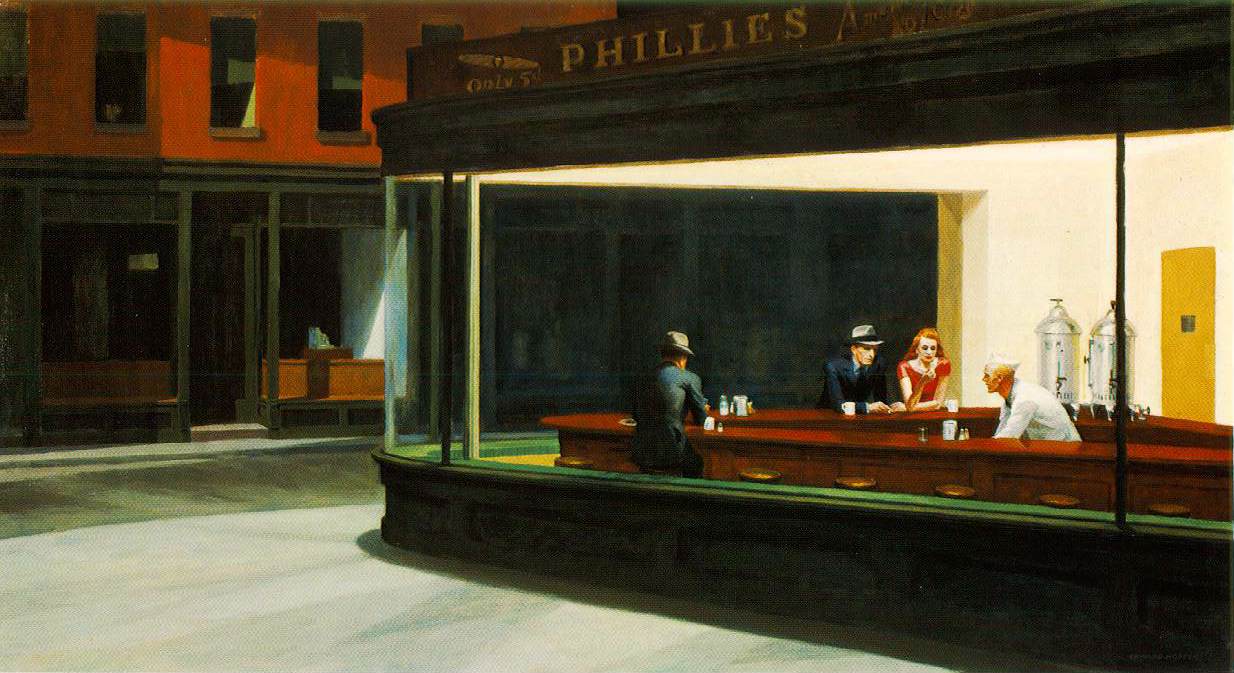
Cartier-Bresson και Edward Hopper

Ο Henri Cartier-Bresson είναι, ίσως, ο φωτογράφος που συνέβαλε περισσότερο από οποιονδήποτε άλλον στο να αναγνωριστεί ένα μηχανικό μέσο, όπως είναι η φωτογραφία, σαν μορφή καλλιτεχνικής έκφρασης. Από μικρός ήθελε να γίνει ζωγράφος και όταν έφτασε σε μεγάλη ηλικία και εγκατέλειψε την φωτογραφική μηχανή, έπιασε τα πινέλα και άρχισε να ζωγραφίζει. Βλέποντας τις φωτογραφίες του, πολλές από αυτές μοιάζουν σαν πίνακες ζωγραφικής. Ένας φωτογράφος που ζωγράφιζε πάνω στο φιλμ.


Την αντίστροφη διαδρομή, έχω την αίσθηση, ακολουθεί το έργο του ζωγράφου Edward Hopper. Tα θέματα του είναι κατεξοχήν φωτογραφικά και η τεχνοτροπία του υπογραμμίζει την αναφορά στη φωτογραφική τέχνη. Ένας ζωγράφος που φωτογράφιζε πάνω στον καμβά.


Saturday, February 25, 2012

Anders Petersen

The only true philosopher I had the privilege to meet in person: the Swedish photographer Anders Petersen.
I think it is worth to watch this short interview of his, even if one is not interested in photography

Anders Petersen from Türkiye'de Zaman/Time in Turkey on Vimeo.

Sunday, September 25, 2011

Θεατρικά βραβεία στον καιρό του Σοφοκλή


Quiz: Ποιές θέσεις κατέλαβαν οι δύο, κατά πολλούς, κορυφαίες τραγωδίες της αρχαιότητας, η «Μήδεια» του Ευριπίδη και ο «Οιδίπους Τύραννος» του Σοφοκλή, όταν διαγωνίστηκαν για τa θεατρικά «όσκαρ» της εποχής, τα Μεγάλα Διονύσια;

Απάντηση: Το 431 π.Χ η «Μήδεια» ήρθε τρίτη- νικητής ήταν το έργο κάποιου Ευφορίωνα (γιος του Αισχύλου, διαβάζω). Το 427 π.Χ ο «Οιδίπους» έχασε από το έργο κάποιου Φιλοκλή (ανηψιός του Αισχύλου, διαβάζω).

Τι να συμπεράνουμε από την «αποτυχία» τους;
α) Η οικογένεια Αισχύλου είχε γερό βύσμα στην κριτική επιτροπή και σάρωνε τα βραβεία.
β) Ο Ευφορίωνας και ο Φιλοκλής ήταν κολοσσιαία ταλέντα που τα αριστουργήματα τους έκαναν τον Ευριπίδη και τον Σοφοκλή να φαίνονται δευτεράτζες, αλλά ατυχώς μόνο οι σύγχρονοι τους αθηναίοι είχαν την ευκαιρία να θαυμάσουν.
γ) Το πιο αξιόπιστο κριτήριο για την αξία ενός έργου είναι η αντοχή του στο χρόνο.
δ) Ουδείς προφήτης στον τόπο του και στην εποχή του.

Sunday, April 3, 2011

About the Nude in Art

For many viewers, the more a body is naked, the more it should be clothed in conventions.

John Berger, The Shape of a Pocket (Chapter: Degas)

Tuesday, December 14, 2010

John Lennon about Happiness

When I was 5 years old, my mother always told me that happiness was the key to life. When I went to school, they asked me what I wanted to be when I grew up. I wrote down ‘happy.’ They told me I didn’t understand the assignment, and I told them they didn’t understand life.

John Lennon

Thursday, September 23, 2010

Sartre: about writng

“The function of the writer,” wrote Sartre, “is to act in such a way that nobody can be ignorant of the world and that nobody may say that he is innocent of what it is all about.”

Saturday, July 31, 2010

Art events around the world

A useful link with a global art events list:

http://events.nytimes.com/iht/artsguide/index.php

Sunday, April 25, 2010

Holland Festival 2010

The Old Vic (the director of which is Kevin Spacey) and Oscar winner director Sam Mendes will be present in the Holland Festival, with two plays by Shakespeare : "As you like it" and "The Tempest".

The Festival lasts from 1 to 23 June. www.hollandfestival.nl

Sunday, April 18, 2010

Brecht and Hitler

Η αθάνατη προειδοποίηση του Μπρεχτ για τον Αδόλφο Χίτλερ: «Μη χαίρεστε με την ήττα του, άνθρωποι:γιατί μπορεί ο κόσμος να σηκώθηκε και να σταμάτησε τον μπάσταρδο, αλλά η σκύλα που τον γέννησε έχει πάλι κάψες».

Brecht on Hitler: "Do not rejoice in his defeat, you men. For though the world has stood up and stopped the bastard, the bitch that bore him is in heat again."

A final quote by Berthold Brecht from his play The Resistible Rise of Arturo Ui

Somethin from Rilke

NO ONE LIVES HIS LIFE

Disguised since childhood,
haphazardly assembled
from voices and fears and little pleasures,

We come of age as masks.
Our true face never speaks.

Somewhere there must be storehouses
where all these lives are laid away
like suits of armor or old carriages
or cloths hanging limply on the walls.

Maybe all paths lead here,
to the repository of unlived things.